

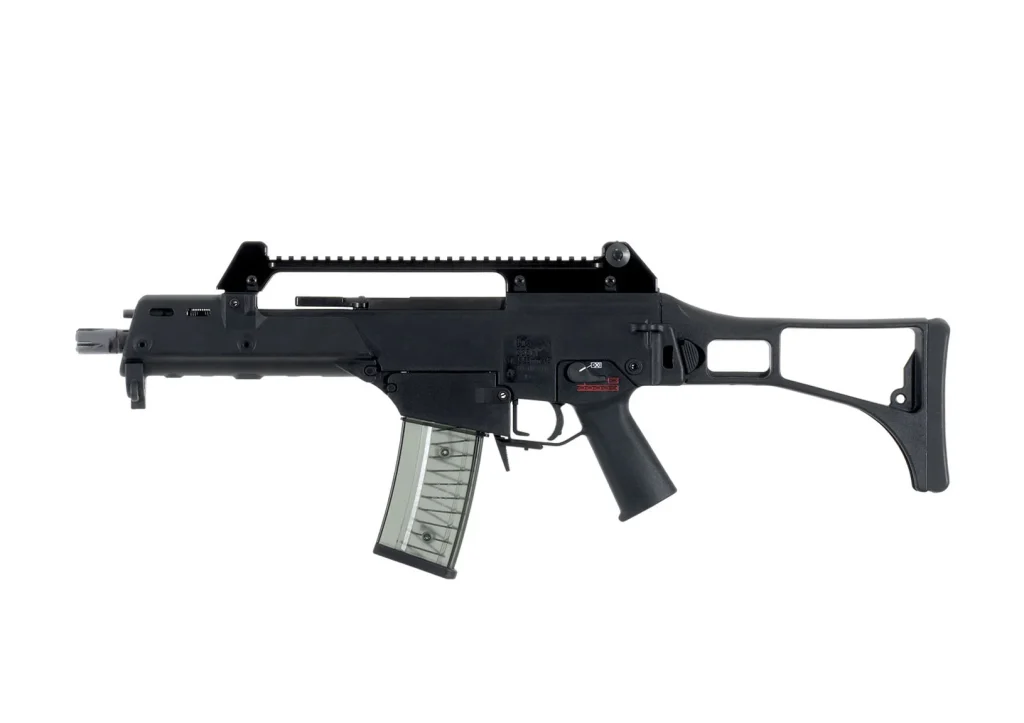
You’ll find the G36 to be Heckler & Koch’s flagship 5.56×45mm NATO assault rifle, featuring advanced German engineering and a lightweight polymer construction at 3.63kg combat-ready. It’s equipped with a free-floating 480mm barrel, ZF 3×4° dual optical sight system, and short-stroke gas piston operation. While serving as Germany’s primary service weapon since 1996, the G36 delivers tactical versatility through its folding stock and 30-round translucent magazine. There’s much more to discover about this precision-engineered platform.
Key Takeaways
- The G36 is a 5.56×45mm NATO assault rifle made by Heckler & Koch, serving as the Bundeswehr’s standard weapon since 1996.
- Features include a lightweight polymer construction, folding stock, and integrated dual optical sight system for enhanced targeting capabilities.
- The rifle uses a short-stroke gas piston system and free-floating barrel design for reliable operation and improved accuracy.
- Standard configuration includes a 30-round translucent magazine, with compatibility for 100-round Beta C-Mag options.
- While offering excellent ergonomics and versatility, the G36 has documented issues with accuracy degradation under sustained heat exposure.
Description
The Heckler & Koch G36 represents a cutting-edge 5.56×45mm NATO assault rifle that combines tactical versatility with German engineering precision.
You’ll find its free-floating barrel delivers optimal accuracy, while the ergonomic handle integrates seamlessly with the modular design. The rifle features a folding stock, translucent 30-round magazine, and advanced ZF 3×4° dual optical sight system for both magnified and reflex targeting capabilities.
Price Range
Pricing for the H&K G36 reflects its position as a premium-tier tactical platform, with current market values showing a notable shift from its original $6,999.00 MSRP. You’ll find enhanced fire control and reinforced magazine well integration at the reduced price point of $5,999.99, representing a 14% tactical investment optimization.
| Price Component | Value |
|---|---|
| Original MSRP | $6,999.00 |
| Current Price | $5,999.99 |
| Total Savings | $999.01 |
| Discount Rate | 14% |
| Stock Status | Notify When Available |
Specifications
The G36’s combat-ready configuration weighs 3.63 kg and features a free-floating barrel system chambered in 5.56×45mm NATO. You’ll find its reinforced polymer construction provides excellent durability while maintaining a lightweight profile suited for tactical operations. The rifle’s standard magazine capacity is 30 rounds using proprietary translucent polymer magazines, though it’s compatible with 100-round Beta C-Mags in the MG36 variant.
| Specification | Measurement | Notes |
|---|---|---|
| Weight | 3.63 kg | Combat-ready |
| Length | 999 mm | Stock extended |
| Barrel | 480 mm | Free-floating |
| Caliber | 5.56×45mm | NATO standard |
| Capacity | 30/100 rounds | Standard/Beta C-Mag |
Weight
When comparing weight specifications across G36 variants, the standard G36 rifle registers at 3.63 kg (8.00 lb), achieving its lightweight profile through extensive use of corrosion-resistant synthetic materials.
You’ll find slight variations in weight across the family, with the civilian SL8 being marginally heavier at 3.9 kg (8.6 lb), while the MG36’s weighted barrel and bipod handguard add to its carry weight.
Barrel Length
Barrel configurations across the G36 platform offer three distinct lengths, optimizing the rifle’s versatility for various tactical scenarios.
You’ll find the standard G36 equipped with a 480mm (18.9 in) barrel, ideal for long-range sight engagement. The G36K carbine reduces barrel length to 318mm (12.5 in), while the compact G36C features a 228mm (9.0 in) barrel length, perfect for close-quarters operations.
Material Made Out Of
Featuring advanced polymer construction, Heckler & Koch’s G36 rifle incorporates lightweight synthetic materials throughout its design to maximize durability while minimizing overall mass.
You’ll find corrosion-resistant synthetic materials used extensively in the rifle’s construction, from its reinforced polymer receiver to its translucent magazine system. The free-floating barrel assembly attaches to the receiver via a specialized mounting nut for optimal accuracy.
Chambered In
The G36’s primary chambering in 5.56×45mm NATO represents a significant evolution from H&K’s earlier 7.62mm G3 platform. You’ll find this lighter cartridge allows for enhanced maneuverability while maintaining optimal ballistic performance through the rifle’s short-stroke gas piston system.
The switch to 5.56×45mm NATO aligns with modern infantry requirements, providing you with improved terminal ballistics and reduced recoil compared to the G3’s larger caliber.
Capacity
Standard-issue G36 rifles come equipped with proprietary 30-round translucent polymer magazines, offering you rapid assessment of remaining ammunition through visual indexing.
The MG36 variant accepts 100-round Beta C-Mags for sustained fire operations.
You’ll find civilian variants like the SL8 available with single or double-stack magazine wells, while the HK243 can be modified to accept STANAG magazines for enhanced compatibility.
Trigger Pull
Moving from magazine options to firing mechanics, operators will find the G36’s trigger mechanism exemplifies German engineering precision. You’ll experience a two-stage trigger pull ranging from 2.5 to 3.5 pounds, featuring a light initial take-up followed by a crisp break.
The short, tactile reset enhances your sustained fire capabilities, while the consistent performance ensures reliable accuracy during extended engagements.
Safety?
Built around operator safety, the G36’s control interfaces feature an ambidextrous selector switch with a three-position 0°/45°/90° rotation pattern.
You’ll find additional safety features including an integrated brass deflector that prevents spent casings from striking the operator, and a bolt that doubles as a dust cover when the weapon isn’t in use. The automatic bolt hold-open can be deactivated if desired.
Action
Operating through a short-stroke gas piston system, the G36 delivers reliable cycling of 5.56×45mm NATO ammunition while minimizing reciprocating mass.
You’ll find the rotary bolt locks back automatically after expending the last round, with an option to deactivate this feature. The gas block drives a self-folding charging handle, while the bolt doubles as a dust cover.
A brass deflector manages spent case ejection.
Optic Ready?
The G36’s integrated optics system stands as a defining feature, complementing its efficient gas operation. You’ll find a ZF 3×4° dual optical sight combining both magnified telescopic and unmagnified red dot sight capabilities.
The ambient light-powered reflex sight includes a 200m zero with bullet drop compensation. Export models feature a simplified 1.5× telescopic sight, while the platform maintains compatibility with the Hensoldt NSA 80 night vision optic.
Picatinny Rail?
While standard Picatinny rails weren’t part of the original design, you’ll find the G36 equipped with a proprietary mounting system that incorporates a specialized top rail secured via a dedicated nut assembly.
The modular design allows for ambidextrous accessory mounting while maintaining a free-floating barrel configuration. You can also integrate standard Picatinny rails on the forend’s underside for additional tactical accessories.
Review
The G36’s lightweight polymer construction and modular design make it an excellent choice for military and law enforcement operators seeking rapid target acquisition and simplified maintenance, while its adoption by over 40 countries’ armed forces speaks to its combat effectiveness.
You’ll find the rifle’s most significant drawback in its documented accuracy degradation during sustained fire in high-temperature conditions, particularly noted during deployments in Afghanistan. Despite this thermal sensitivity issue, the G36 maintains exceptional reliability in standard operating conditions and sees extensive service with German special forces, Spanish armed forces, and numerous counter-terrorism units worldwide.
Pros
Combining advanced polymer construction with superior ergonomics, H&K’s G36 delivers exceptional performance in a lightweight battle rifle platform. You’ll find the integrated carrying handle houses a dual-sight system, while the short barrel maintains accuracy through free-floating design.
| Feature | Tactical Advantage |
|---|---|
| Ambidextrous Controls | Enhanced operator flexibility |
| Short-stroke Piston | Superior reliability in adverse conditions |
| Folding Stock | Rapid deployment capability |
The translucent magazines and corrosion-resistant materials ensure you’re always combat-ready with clear ammunition status checks.
Cons
Despite its innovative features, significant operational limitations have emerged with the G36 platform. The rifle, formerly known for reliability, exhibits accuracy degradation during sustained fire. The G36E and other variants suffer from polymer component thermal issues and environmental performance challenges.
| Limitation | Impact |
|---|---|
| Heat Sensitivity | POI shift under sustained fire |
| Polymer Construction | Reduced durability in field |
| Proprietary Design | Limited magazine compatibility |
The dual optic integration, while advanced, creates additional training requirements and maintenance complexities in tactical environments.
Reliability
Initial field reports from Afghanistan revealed significant performance variations in the G36’s combat reliability profile. While the Bundeswehr’s investigation initially pointed to ammunition quality, subsequent Fraunhofer testing showed concerning accuracy degradation under heat stress.
Despite these findings, the G36’s continued adoption by law enforcement and military units worldwide suggests acceptable operational reliability when properly maintained, though questions about its combat performance persist.
Most Commonly Used By
Service adoption of the G36 platform centers primarily around the Bundeswehr, which has fielded the rifle as its standard-issue weapon since 1996.
You’ll find significant deployment with the Spanish Armed Forces, who transitioned from CETME rifles to the G36 in 1998.
The service rifle’s operational footprint extends to Saudi Arabia through licensed production, and it’s been selected by specialized units like US Task Force 23.
Similar Models
Several variants of the G36 have been developed for civilian and export markets, each with distinct configurations and capabilities.
You’ll find the SL8 rifle, a semi-automatic 5.56mm civilian version, and the HK243 in .223 Remington that accepts STANAG magazines.
The MG36 was developed as a light support weapon variant, while export models like the G36V omit the original’s dual optics system.
Similar Models From Other Manufacturers
The G36’s presence in the global firearms market has sparked competition from numerous manufacturers developing comparable assault rifles. You’ll find match grade competitors like the Steyr AUG, FN SCAR-L, and Colt M4 Carbine, all chambered in 5.56×45mm NATO.
The Beretta ARX-160 offers similar tactical capabilities for the civilian market, while the CETME Model L represented earlier competition before being replaced by the G36.
Maintenance
Modern G36 rifles feature exceptional ease of maintenance thanks to their corrosion-resistant synthetic construction and self-regulating design elements.
You’ll find the short-stroke gas piston operating system requires minimal upkeep while delivering reliable performance. The bolt doubles as a dust cover, protecting internal components.
A self-folding charging handle and free-floating barrel design further streamline maintenance procedures while ensuring sustained accuracy.
History
Following cancellation of the ambitious G11 caseless ammunition program in the early 1990s, Heckler & Koch initiated development of Project 50 (HK50) to create a successor to their aging G3 battle rifle.
The standard G36, chambered in 5.56×45mm NATO, replaced the 7.62×51mm G3. In 1995, Koch G36 development concluded, with production starting in 1996. NATO’s Quick Reaction Force received initial deliveries in 1997.
Frequently Asked Questions
Was the G36 a Failure?
You can’t call the G36 a failure, despite some quality control issues that emerged. While there were consistent performance concerns under extreme heat conditions, investigations revealed these problems stemmed from ammunition quality rather than the rifle’s design.
With over 260,000 units produced and widespread adoption by military and law enforcement globally, it’s proven itself as a reliable platform that continues to deliver tactical effectiveness through its modular design and advanced optics system.
Was the G36 a Good Rifle?
Like your smartphone’s dependability, you can’t judge a rifle’s worth by social media drama alone. The G36 has proven its reliable performance in countless operational deployments, with minimal manufacturing defects reported across its service life.
You’ll find it excels in tactical applications with its lightweight polymer construction and modular design. While heat-related accuracy shifts exist, they’re within acceptable combat parameters. The platform’s ergonomics and maintenance simplicity make it a solid performer.
What Is the Civilian Version of the G36?
You’ll find several consumer models available as civilian versions of the G36. The primary variants are the HK243, HK SL8, and HK SL9SD.
Each model’s been specifically engineered to meet civilian market regulations while maintaining the G36’s core design features.
The HK243 lets you use STANAG magazines, while the SL8 comes with a proprietary magazine system.
The SL9SD offers unique features like .300 Whisper chambering and a specialized gas operation system.
What Does the G in G36 Stand For?
Like decoding a military cipher, you’ll find that the “G” in G36 stands for “Gewehr,” which is the German word for “rifle.” In the design specifications and manufacturing process, this designation follows Heckler & Koch’s standardized nomenclature system for their tactical weapons.
You’ll notice this pattern across their rifle series, where the “G” prefix indicates a long-arm weapon platform, reflecting German engineering precision in their firearms taxonomy.
Conclusion
You’ll find the G36’s performance absolutely devastating in any tactical environment. This masterpiece of German engineering delivers match-grade accuracy that’ll make your M4 look like a slingshot. While you’re running MOUT operations, you’ll appreciate its zero-retention capability and ambidextrous controls. The polymer receiver might seem unconventional, but you’re getting a platform that’s outlasted countless metal alternatives in extreme conditions.
0 Comments