

https://www.colt.com/product-category/revolvers/single-action-army-series
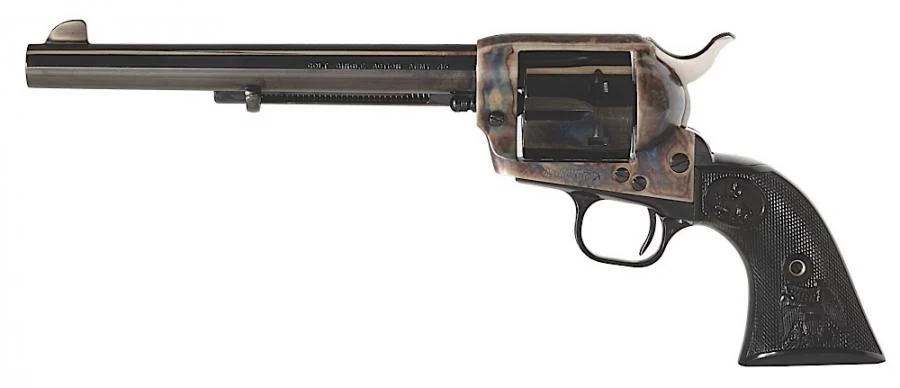
The Colt Single Action Army revolver you’ll encounter today mirrors the iconic 1873 original that served as the U.S. Army’s standard sidearm until 1892. You’ll find it chambered in .45 Colt, .357 Magnum, or .44/40, featuring a 6-shot fluted cylinder and classic walnut grips. Modern variants range from $599 to $1,479, with barrel lengths from 4.75 to 7.5 inches. Its legendary reliability and simple mechanism have established a legacy that continues to unfold.
Key Takeaways
- The Colt Single Action Army is a six-shot revolver that served as the U.S. Army’s standard sidearm from 1873 to 1892.
- Available in multiple calibers including .45 Colt, .357 Magnum, and .44/40, with barrel lengths ranging from 4.75 to 7.5 inches.
- Features a simple, reliable mechanism with a fluted cylinder, and traditional walnut grips, and weighs approximately 2.3 pounds.
- Modern variants range from $599 to $1,479, with standard models at $899 and premium versions featuring special finishes or engravings.
- Known for exceptional durability and accuracy, though reload time is slower compared to modern pistols.
Description
The Colt Single Action Army, a revolutionary single-action revolver, made its debut in 1873 as the U.S. Army’s standard sidearm until 1892. The revolver features a 6-shot fluted cylinder and classic walnut grips, weighing approximately 2.3 pounds.
You’ll find the Single Action Army in various barrel lengths from 4.75 to 7.5 inches, with caliber options including .45 Colt, .357 Magnum, and .44/40.
Price Range
Ranging from $599 to $1,479, modern Colt Single Action Army pistols offer options for various budgets and preferences. You’ll find the standard color case-hardened frame model with blued barrel at $899, while specialty variants command higher prices.
| Model Type | Features | Price |
|---|---|---|
| Standard | Blued barrel | $899 |
| Specialty | Nickel-plated | $1,299 |
| Premium | Engraved/Desperado | $1,479 |
The Single-Action Army’s barrel length affects pricing, with shorter barrels typically costing less than the 7.5-inch version.
Specifications
The Colt Single Action Army’s specifications showcase its versatile design, with barrel lengths ranging from 4.75 to 7.5 inches and an overall weight between 2.3 and 2.9 pounds. You’ll find this six-shot revolver constructed from brass, steel, or stainless steel, with various finishes including nickel-plated and charcoal blue. The pistol’s chambering options span multiple calibers, including .45 Colt, .357 Magnum, .44/40, and .22 LR.
| Specification | Range/Type | Details |
|---|---|---|
| Weight | 2.3-2.9 lbs | Varies by model |
| Barrel Length | 4.75-7.5 inches | Multiple options |
| Capacity | 6 rounds | Fluted cylinder |
| Calibers | Multiple | .45 Colt, .357 Mag, .44/40, .22 LR |
Weight
Standard production models of the Colt Single Action Army weigh 2.31 pounds (1.05 kg) unloaded, with slight variations depending on barrel length and chambering.
You’ll find that cavalry models with 7.5-inch barrels are the heaviest, while sheriff’s and storekeeper’s models with 3-inch barrels are notably lighter. The weight distribution helps manage recoil during firing.
Barrel Length
Colt produced its Single Action Army revolver with multiple barrel length options to serve diverse user needs. The standard barrel lengths included 4.75, 5.5, and 7.5 inches.
You’d find shorter variants in the Civilian/Gunfighter and Artillery models, while sub-4-inch barrels were available in the Sheriff’s Model, Banker’s Special, and Storekeeper.
The rare Buntline Special featured an extended 18-inch barrel.
Material Made Out Of
Built to endure, Single Action Army revolvers feature robust metal construction with several material options. You’ll find them available in traditional blued steel, brass, nickel-plated steel, and stainless steel variants.
The standard model comes with a blued steel frame and barrel, while premium versions showcase charcoal blue, case-hardened finishes, and decorative grips made from simulated pearl, buffalo horn, or ivory.
Chambered In
Originally chambered in the legendary .45 Colt cartridge, the Single Action Army later expanded to accommodate over 30 different calibers throughout its production history.
You’ll find these Colt revolvers offered in popular chamberings like .44-40 Winchester, .357 Magnum, and .38-40. The action proved versatile enough to handle everything from the powerful .44 S&W to the diminutive .22 Long Rifle in Scout models.
Capacity
At its core, the Single Action Army revolver features a standard 6-shot fluted cylinder, though a specialized 12-shot variant emerged for the .22 LR chambering.
This capacity remained consistent through the New Model iterations, with the Single-Action Target Revolver maintaining the same round count across its various caliber options, including .45 Colt, .357 Magnum, and .44/40 configurations.
Trigger Pull
Moving beyond cylinder capacity, the trigger mechanism of the Colt Single Action Army represents a masterpiece of mechanical precision. You’ll find a consistent 4.5 to 5-pound trigger pull with a short 0.25 to 0.30-inch travel distance.
The Colt Single Action’s crisp break and minimal overtravel deliver exceptional control, while its short reset facilitates quick follow-up shots.
Safety?
The rugged simplicity of the Colt Single Action Army’s safety features reflects its 19th-century design philosophy. You’ll find no external safety mechanism, but the half-cock notch lets you refresh your confidence by carrying it with an empty chamber.
The long, heavy trigger pull and manual cylinder rotation serve as natural safety features, requiring deliberate action to refresh after filters are cleared through proper loading procedures.
Action
Single-action simplicity defines this legendary revolver’s operating mechanism. You’ll need to manually cock the hammer before each shot on this classic single-action revolver.
The standard configuration features a 6-shot fluted cylinder, though a 12-shot variant chambered in .22 LR is also available. The rifling follows a right-hand twist pattern ranging from 1:16 to 1:20.
Optic Ready?
Built during an era before modern optics, this classic revolver maintains its original iron sight configuration without factory provisions for mounting scopes or red dots.
If you’re looking to add modern optics, you’ll need custom gunsmithing work, including drilling and tapping the frame. While aftermarket mounting solutions exist, they’re third-party modifications that alter the traditional front sight setup of this 1873 design.
Review
You’ll find the Colt Single Action Army’s legendary reliability stems from its robust, simple mechanism that’s proven itself through military service and civilian use since 1873. While the pistol excels in durability and accuracy, you’ll need to adapt to its slower reload time and six-shot capacity compared to modern firearms.
The Single Action Army’s hefty weight provides excellent recoil management, though this same characteristic makes it less suitable for concealed carry or extended field use.
Pros
Standing as one of the most versatile revolvers ever produced, the Colt Single Action Army delivers exceptional reliability through its time-tested mechanism that’s remained virtually unchanged since 1873. You’ll appreciate its adaptability across multiple configurations:
| Feature | Benefit | Application |
|---|---|---|
| Multiple Barrel Lengths | 4.75″ to 7.5″ options | Concealment to long-range |
| Caliber Variety | .45 Colt to .357 Magnum | Diverse shooting needs |
| Classic Design | Fluted cylinder, iconic hammer | Collector’s value |
| Custom Options | Engraving, specialty finishes | Personal preference |
| Robust Construction | Single-action mechanism | Lasting durability |
Cons
While the Colt Single Action Army boasts numerous advantages, it comes with notable limitations that deserve careful consideration. You’ll find the heavy trigger pull and left-side hammer placement less conducive to rapid firing. The exposed mechanism requires extra maintenance, while the fluted cylinder’s edges can be uncomfortable during extended use.
| Limitation | Impact | User Consideration |
|---|---|---|
| Trigger Design | Slower follow-up shots | Training required |
| Maintenance | Time-consuming cleaning | Regular care needed |
| Cylinder Edges | Hand wear and tear | Protective gear use |
| Frame Size | Limited grip comfort | Hand size matching |
| No Safety | Higher risk profile | Careful handling |
Reliability
Through decades of rigorous testing and real-world use, the Colt Single Action Army has proven itself as one of history’s most reliable handguns. You’ll find its straightforward single-action mechanism requires minimal maintenance while delivering consistent performance.
From military personnel to outlaws alike, users have praised its ability to function reliably in harsh conditions, contributing to its century-long legacy of dependable service.
Similar Models
Over the decades, several manufacturers have produced revolvers inspired by the iconic Colt Single Action Army design. You’ll find customizable options in the Ruger Vaquero and Uberti 1873 Cattleman, both available in various finishes and calibers.
The Taurus Deputy and EMF DLX Californian offer more affordable alternatives while maintaining the classic .45 Colt chambering and traditional aesthetics.
Similar Models From Other Manufacturers
Several firearm manufacturers have crafted quality alternatives to Colt’s legendary Single Action Army revolver. If you’re considering affordability considerations, you’ll find the Ruger Vaquero and Uberti 1873 Cattleman offering premium-quality .45 Colt options.
For more budget-conscious choices, the EMF DLX Californian and Taurus Deputy revolvers provide similar aesthetics and functionality while maintaining the classic single-action design.
Maintenance
Regular maintenance of the Colt Single Action Army revolver is crucial for preserving its reliability and longevity. You’ll need to follow proper disassembly precautions to prevent losing small components during cleaning.
Apply high-quality gun oils and solvents that are compatible with the revolver’s materials. Polish action components for smooth operation, and regularly inspect for worn parts that may need replacement.
History
The Colt Single Action Army revolver emerged during the U.S. government’s service revolver trials in 1872, marking the beginning of its legendary status. Following military adoption in 1873, production reached 357,859 units by 1940, with nearly half chambered in .45 Colt.
While the Model 1892 replaced it as the standard service revolver in 1893, you’ll find it continued serving other military branches.
Frequently Asked Questions
Is Colt Still Making the Single Action Army?
Yes, you’ll find that Colt continues contemporary production of the Single Action Army revolver. While they’ve had different production generations since 1873, they’re currently manufacturing fourth-generation models.
You can get one in various calibers, including .45 Colt, .357 Magnum, and .44/40 Winchester. They’re offering multiple barrel lengths, finishes, and custom options, with prices ranging from $599 to $1,479 for new models.
What Caliber Was the Colt Single Action Army?
You’ll find it fascinating that while the .45 Colt was the original and most famous caliber, you actually had over 30 different caliber variations to choose from.
The .45 Colt version launched a 255-grain bullet at 970 feet per second using 40 grains of black powder. You could also get it in popular options like .44-40, .38-40, .32-20, and .41 Colt. There was even a .22 rimfire version called the Scout.
How Much Did a Colt Single Action Army Cost in 1873?
When you look at affordable pricing in 1873, you’d find the Colt Single Action Army retailing for $17.50 per unit from the factory. That’s equivalent to about $400-450 in today’s money.
If you’d ordered directly from Colt’s catalog, you wouldn’t need to pay a middleman markup. The military contract price was even better – the U.S. government paid just $13.75 each when purchasing in bulk quantities.
What Is the Difference Between a Colt Navy and a Colt Single Action Army?
You’ll notice several key differences between these iconic revolvers. The 1851 Colt Navy used a .36 caliber cap-and-ball system with a 7.5-inch barrel, while the 1873 Single Action Army introduced cartridge ammunition (primarily .45 Colt) with multiple barrel lengths.
The SAA’s improved lockwork mechanism and fixed cylinder enhanced rapid fire accuracy compared to the Navy. You’ll also find the SAA’s more refined design revolutionized revolvers, replacing the Navy’s older percussion system.
Conclusion
You’ll find the Colt Single Action Army stands as both a legendary firearm and a pivotal piece of American history. While modern revolvers offer superior mechanics, nothing matches the raw authenticity of the “Peacemaker.” From its debut in 1873 to today’s reproductions, it’s transformed from a military sidearm to a collector’s prize. Whether you’re a shooter or collector, you’re holding more than a gun—you’re gripping 150 years of heritage.
0 Comments