

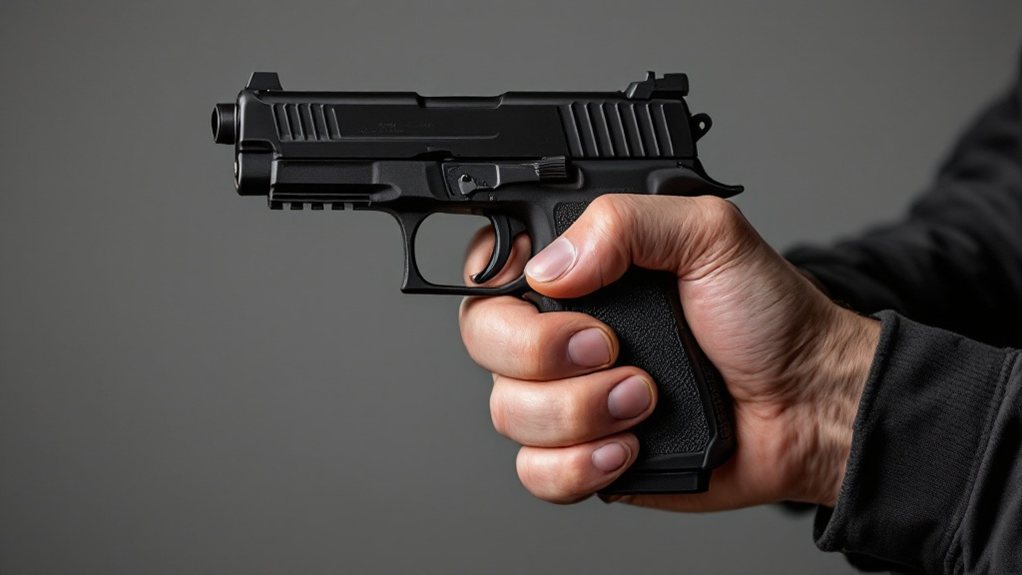
To master your pistol grip position, start by positioning your dominant hand high on the backstrap with firm contact between your hand’s web and the tang. Next, flag your dominant thumb outward while applying downward pressure with your support hand. Build grip strength through targeted exercises and maintain 360-degree contact with the weapon. Keep your elbows slightly bent for recoil control and practice proper arm extension. These fundamentals are just the beginning of developing superior shooting mechanics.
Key Takeaways
- Position your dominant hand as high as possible on the backstrap with web firmly against the pistol’s tang.
- Create a tight, gap-free 360-degree contact between both hands and the grip frame.
- Align both thumbs properly – dominant thumb flagged out, support thumb parallel to barrel.
- Keep wrists locked and aligned with forearms to maximize recoil control.
- Maintain consistent grip pressure while keeping fingers properly positioned on frame and trigger.
Master Your Hand Placement and Alignment
A proper pistol grip starts with masterful hand placement and alignment. Position your dominant hand as high as possible on the backstrap to redirect recoil force and maintain front sight control. Your shooting hand should create a firm, gap-free connection between the web of your hand and the pistol’s tang.
Keep your grip hand perfectly aligned with your forearm to create a solid foundation that supports efficient slide movement and enhances recoil management.
Don’t rotate your hand inward when reaching for the trigger – this compromises your control and weakens your ability to manage muzzle flip. Instead, maintain straight alignment throughout your grip.
Perfect Your Thumb Position and Pressure Points
Building on proper hand alignment, thumb placement plays a key role in controlling your pistol. Your grip strength needs to focus on specific pressure points rather than using a basic crush grip. The web of your hand forms the foundation of your firing grip, while proper thumb positioning enhances front-to-back pressure for optimal recoil control.
To maintain a secure pistol grip:
- Flag your dominant thumb outward to create space for your support hand
- Push the base of your dominant thumb forward and down while engaging your pinky upward
- Position your support hand thumb parallel to your arm by canting the wrist forward
- Apply downward pressure with your dominant thumb against the base of your support thumb
These pressure points create a locked grip system that maximizes control while minimizing unwanted rotation during recoil management.
Optimize Your Grip Strength and Control
Developing optimal grip control requires mastering both physical strength and technique. You’ll need to build your forearm muscles and hand muscles through targeted exercises like farmer’s walks and plate pinches to establish a foundation for consistent grip pressure.
Regular dry-fire practice helps you perfect your trigger control without developing a flinch response. Experiment with different hand positions on the grip frame until you find what works best for your unique hand size and strength level. This personalized approach improves both accuracy and recoil control.
Use video analysis or seek instruction from an experienced shooter to evaluate your technique. They can spot subtle issues in your grip strength and pressure distribution that you might miss. Combine this feedback with dedicated range time to build the muscle memory needed for reliable performance.
Apply the 360-Degree Contact Principle

To master recoil control and maintain accuracy, you’ll need to implement the 360-degree contact principle around your pistol’s grip. This unified grip technique ensures proper muzzle control and consistent shot placement through even pressure distribution.
Apply firm front-to-back pressure with your dominant hand while maintaining side-to-side compression with your support hand. Eliminate any gaps between your hand and the pistol’s tang to prevent recoil energy loss. Maintain proper thumb, finger, and wrist alignment for consistent grip positioning. Develop grip strength and muscle memory through regular dry-fire practice.
Fine-Tune Your Arm Extension and Stance
While maintaining a proper grip is essential, your arm position plays a crucial role in managing recoil and achieving consistent accuracy. Keep your elbows slightly bent to effectively control recoil and reduce muzzle flip – don’t lock them, as this diminishes your ability to absorb recoil forces.
Find your optimal stance by positioning your arms at a middle distance between full extension and close-in grip. This allows you to apply both strong side-to-side pressure and front-to-back pressure for maximum control. When drawing your pistol, stage your support hand at your lower chest. As you drive the weapon toward the target, slide your support hand underneath, ensuring your trigger finger makes contact with the bottom of the trigger guard. Practice this position until it becomes second nature, focusing on consistency with each presentation.
Frequently Asked Questions
What Is the Best Position for a Pistol Grip?
For the best pistol grip position, you’ll want proper hand placement high on the backstrap with a firm, two-handed grip stability. Keep your wrist aligned comfortably and straight.
Place your trigger finger alongside the frame until you’re ready to shoot. Your support hand should fill the empty spaces, creating a solid foundation for recoil management.
Practice your sight alignment and target acquisition skills through dry fire practice. Remember, a consistent grip enables better accuracy and control.
What Is the Most Stable Gripping Procedure for Handgun Shooting?
For stable handgun shooting, you’ll want to place your shooting hand high on the backstrap while maintaining proper trigger finger alignment. Keep your wrist angle controlled and firm.
Apply balanced grip pressure with your shooting hand front-to-back and your non-shooting hand providing side pressure. Focus on your sight picture while managing recoil through proper hand placement.
Practice your draw stroke technique and target acquisition speed regularly with an unloaded firearm for consistent improvement.
How Far Should Fingers Wrap Around a Pistol Grip?
Your three lower fingers should wrap firmly and completely around the pistol grip, while keeping your index finger straight and off the trigger until ready to shoot.
For optimal shooting accuracy and recoil management, ensure your palm placement creates full contact with the grip. Whether using a two-handed or one-handed grip, maintain consistent grip tightness without excessive force.
Your wrist position should be straight and locked to support proper trigger control and stable shooting stance.
What Is the Best Stance for Pistol Shooting?
While beginners often stand rigid like statues, proper pistol shooting requires fluid stability. You’ll find the isosceles or modified Weaver stance most effective.
Plant your feet shoulder-width apart, lean slightly forward, and distribute your body weight evenly. Keep your arms slightly bent for recoil management, align your dominant eye with sights, and maintain a firm grip. This stance creates a stable platform for consistent sight picture, reliable target acquisition, and effective muzzle control.
Conclusion
Studies show that shooters who master proper pistol grip technique can reduce shot group sizes by up to 40% compared to those using inconsistent grip methods. You’ll see dramatic improvements in your accuracy and control by consistently practicing these five fundamental grip steps. Remember, it’s not about grip strength alone – it’s about proper technique, consistent form, and always following safety protocols during your training sessions.


0 Comments