


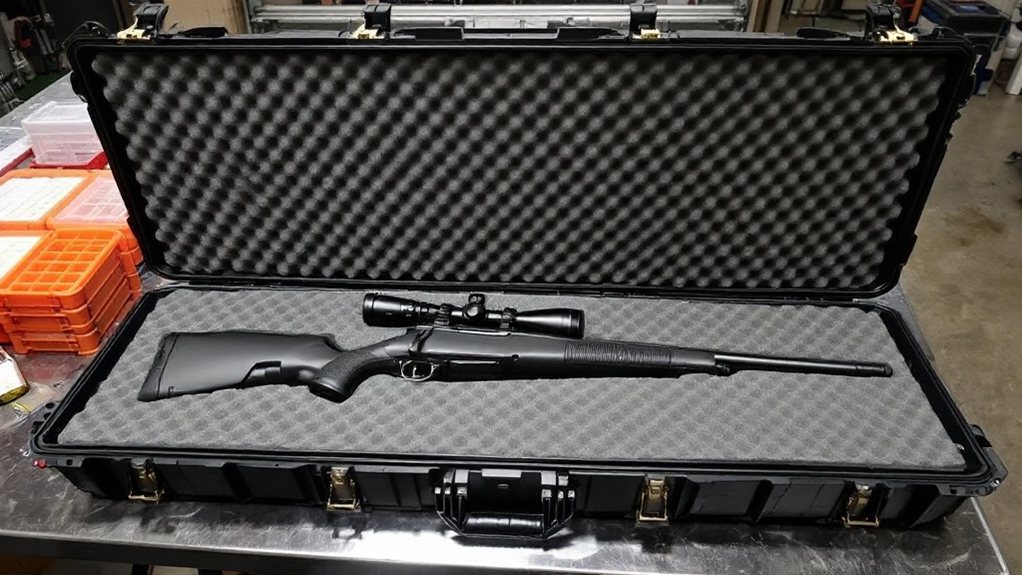
When transporting firearms, you’ll need a hard-sided case with secure locks that prevent unauthorized access. Your case must be constructed from high-strength materials like reinforced polymer or aluminum, with multiple locking points to prevent flex or gaps. Keep firearms completely unloaded, and store ammunition separately in compliance with TSA regulations. You’re responsible for meeting all federal and state requirements for proper firearm transport. Understanding the specific details of these requirements will ensure your compliance and security.
Key Takeaways
- Firearms must be transported in a hard-sided case with secure locks that prevent unauthorized access during transit.
- Always unload firearms completely and store ammunition separately in original packaging within checked baggage.
- Use high-quality locks at all access points, with TSA-approved locks being permitted but not necessarily the best security option.
- The transport case must be made of strong materials like reinforced polymer or aluminum with no flex points when pressed.
- Declare firearms and ammunition at check-in, following specific airline regulations and quantity limits for ammunition transport.
Essential Requirements for Firearm Transport Cases
When transporting firearms through airports or across state lines, you’ll need a hard-sided case that meets strict security requirements. Your case must be equipped with secure locks that prevent unauthorized access, ensuring only you can open the container. Before placing your firearm in the hard-sided case, you must verify it’s completely unloaded.
To avoid delays and potential legal issues during screening, you’ll need to comply with both TSA and airline-specific regulations for firearm transport. This includes properly preparing and securing your weapon according to current guidelines. The responsibility falls on you to ensure your transport case meets all necessary specifications.
Taking time to verify these requirements in advance will help maintain safety standards and prevent complications during your travel process.
TSA-Approved Lock Selection and Usage
When selecting locks for your firearm transport case, you’ll need to choose between TSA-approved combination locks, keyed locks, or standard non-TSA locks that meet your security preferences.
You must secure all access points on your case with appropriate locks, ensuring each zipper, latch, or opening is properly protected to prevent unauthorized entry. While TSA-approved locks offer convenience during inspections, you can opt for regular high-security locks with the understanding that agents may need to cut them for mandatory examinations.
Lock Types For Cases
Selecting the right lock for your firearm transport case requires careful consideration of TSA regulations and security requirements. When securing your checked firearm case, make sure to choose standard keyed or combination locks rather than TSA-approved luggage locks, as these can be accessed by anyone with a TSA master key.
For maximum security, invest in high-quality, tamper-evident locks that can’t be easily compromised. Your chosen lock must create a secure seal and resist manual prying attempts. Avoid budget locks that might fail during transport, potentially exposing your firearm to unauthorized access. While TSA-approved locks are permitted for gun cases, they’re not your best option for maintaining exclusive control over your firearm. The lock you select should provide both durability and peace of mind throughout the transportation process.
Securing Multiple Access Points
Beyond choosing the right type of lock, proper placement and securing of multiple access points demands equal attention. When traveling with firearms in checked baggage, you’ll need to strategically secure your gun case with multiple TSA-approved locks. Install locks at different entry points to create a comprehensive security system.
| Access Point | Primary Lock | Secondary Lock |
|---|---|---|
| Front Panel | TSA Lock | Tamper Seal |
| Side Panel | TSA Lock | Security Bolt |
| Main Zipper | TSA Lock | Cable Lock |
Your locked case must prevent unauthorized access while remaining accessible for TSA inspection. Don’t rely on combination locks, as they can delay screening procedures. Before surrendering your firearm case to airline personnel, verify that each lock is properly engaged and showing no signs of tampering. Test all access points to ensure they’re fully secured.
Avoiding TSA Master Keys
The critical distinction between TSA-approved and non-TSA locks determines your firearm case’s ultimate security. When selecting a type of lock, avoid TSA-accessible options since TSA agents possess master keys that can compromise your case’s integrity. Instead, choose standard key or combination locks that only you can access.
Your firearms deserve maximum protection with locks that can’t be breached by universal master keys. You’ll gain complete control over who accesses your weapons during transport. You’ll prevent unauthorized handling of your firearms by airline personnel. You’ll ensure compliance with federal regulations while maintaining superior security.
Select high-quality, tamper-resistant locks that can’t be easily pried open. While TSA locks are permissible, non-TSA locks provide better security for your firearm case and help maintain the integrity of your checked luggage during transit.
Hard-Sided Case Specifications and Standards
When selecting a hard-sided gun case for air travel, you’ll need one constructed from high-strength materials like reinforced polymer, aluminum, or heavy-duty ABS plastic that can withstand impact testing standards.
Your case must feature strategically placed lock points that prevent any flex or gap from forming when pressure is applied to the case’s edges or corners. The case’s structural integrity should include reinforced corners, full-length hinges, and overlapping seals to create a completely tamper-proof enclosure that meets TSA’s stringent requirements for firearm transport.
Case Material Requirements
Modern firearm transport cases must meet rigorous material standards to comply with TSA regulations and ensure safe transport. Your case should be constructed from high-impact polymer or polycarbonate that can withstand rough handling and protect your firearm.
The top of the case needs reinforced construction to prevent any unauthorized access or damage during transit.
- Choose materials proven to resist impact and prevent case deformation
- Select cases with industrial-grade polymers that won’t crack under pressure
- Ensure your case features reinforced corners to protect against drops
- Invest in materials that maintain integrity in extreme temperatures
Quality materials not only satisfy TSA requirements but also provide peace of mind during travel. The durability of polycarbonate and high-impact polymers ensures your firearms remain secure and protected throughout your journey while meeting all necessary regulations for air transport.
Lock Placement Standards
Proper lock placement on firearm transport cases demands strict adherence to TSA and airline regulations. Your hard-sided case must have strategically placed locks that prevent any possibility of prying the container open. While TSA-approved locks are acceptable, you shouldn’t use ones that give TSA independent access to the case.
For maximum security, you’ll need to attach the locked firearm case inside your checked luggage using a cable lock. This creates an additional layer of protection during transit. You should position the case so it can’t shift during transport, using appropriate padding or wedging techniques.
If you’re transporting a firearm with a removable slide, it’s recommended to separate these components within the case to minimize potential complications during security screening.
Impact Resistance Testing
Rigorous impact resistance testing ensures your firearm transport case can withstand extreme physical abuse during travel. Pelican’s engineering standards meet or exceed military specifications and IP67 requirements, providing superior protection for your firearms as they move through conveyor belt systems and endure rough handling.
When selecting a hard-sided case, you’ll want protection that’s been tested against:
- High-impact drops that could shatter lesser cases and damage your firearms
- Crushing forces that simulate stacked luggage and equipment
- Extreme environmental conditions including water submersion and dust exposure
- Repeated impact stress from automated baggage handling systems
The VAULT and AIR Travel series utilize advanced polymer construction that’s been specifically engineered to absorb shock while maintaining structural integrity. This military-grade protection ensures your firearms remain secure and undamaged throughout transport.
Proper Ammunition Storage During Transport
Safe ammunition storage is a critical component of firearm transport that requires strict adherence to specific guidelines. TSA regulations mandate that you must pack your ammunition in original factory packaging or a secure locked container, with an 11-pound maximum limit per passenger.
| Storage Requirements | Specifications |
|---|---|
| Weight Limit | 11 pounds max |
| Packaging Type | Factory or locked case |
| Magazine Status | Covered if loaded |
| Check-in Location | Ticket counter only |
| Tracking Option | AirTag in magazine well |
Your loaded magazines are permitted if ammunition is fully covered, while unloaded magazines should be boxed or secured in the firearm case. You’ll need to check in your luggage at the ticket counter, as curbside check-in isn’t allowed for firearms. For additional security, consider placing an Apple AirTag inside the magazine well of your firearm case to track your equipment during transport.
Vehicle Storage Options and Security Measures
You’ll find enhanced security through modern vehicle storage systems that offer both console-mounted lockboxes and custom-fitted gun safes. Your vehicle’s design and interior layout will determine whether a lockable console mounting system or a dedicated vehicle safe proves more practical for your needs.
Consider factors like quick access, concealment, and theft resistance when selecting between these two primary options for securing firearms in your vehicle.
Lockable Console Mounting Systems
Vehicle security demands reliable protection for firearms during transport, and lockable console mounting systems offer an effective solution. These heavy-duty systems attach securely to your vehicle’s center console, providing a concealed yet accessible storage location for your firearms. You’ll find that most systems accommodate various handgun and small rifle sizes through customizable storage configurations.
- You’ll gain peace of mind knowing your firearm is secured with tamper-resistant locks
- You’ll maintain quick access while keeping weapons hidden from prying eyes
- You’ll protect your valuable firearms from theft with robust mounting options
- You’ll ensure legal compliance in firearm transportation requirements
When selecting a lockable console mounting system, consider units that bolt or cable directly to your vehicle’s frame. This installation method delivers maximum security while maintaining the discrete storage benefits that make these systems increasingly popular among responsible firearm owners.
Vehicle-Specific Safes Installation
Installing a purpose-built gun safe in your automobile provides the highest level of security for transporting firearms. You’ll need to select a safe that’s specifically designed for your vehicle’s make and model to ensure proper fitment and maximum protection.
When installing vehicle-specific gun safes, you must securely bolt them to your car’s frame or floor pan in a concealed location. This prevents theft and unauthorized access while maintaining discretion. Choose a safe with robust locking mechanisms and verify it meets your state’s legal requirements for in-vehicle firearm storage.
Regular maintenance of your vehicle’s gun safe is crucial. You should check the mounting hardware, locking system, and overall integrity monthly. This ensures your firearms remain secure and compliant with local regulations during transport.
Cross-State Travel Regulations and Compliance
When traveling across state lines with firearms, understanding and following federal and state transportation laws becomes critically important. You’ll need to research each state’s specific requirements before your journey, as regulations can vary significantly. TSA agents require proper declaration and documentation of firearms at security checkpoints.
You must immediately notify law enforcement if stopped while transporting firearms across state lines to avoid serious legal consequences. You’ll face hefty fines or imprisonment if you fail to properly secure firearms during interstate travel. Your concealed carry permit may not be recognized in certain states, putting you at risk of arrest. You’re responsible for knowing and following each jurisdiction’s magazine capacity and ammunition restrictions.
Always transport firearms unloaded, in locked hard cases, separate from ammunition, and inaccessible from the passenger compartment.
Air Travel Documentation and Procedures
Airlines require strict documentation and inspection procedures for traveling with firearms in checked baggage. When you arrive at the ticket counter, inform the agent that you’d like to declare an unloaded firearm. Attach your LEOSA retired cop carry authorization to the exterior of your firearm case for quick verification by TSA personnel.
Be prepared to wait at the counter while TSA inspects your luggage, as many airports require this step before loading. It’s a good idea to know your specific airline’s delivery procedures.
Southwest and United will place handgun cases on the regular baggage carousel, but require long gun case pickup at their baggage office. American and Delta have implemented stricter policies, routing all firearm-containing luggage through their baggage claim offices for enhanced security.
Securing Firearms Within Transport Cases

Proper storage inside transport cases helps ensure both security and compliance with federal regulations. You’ll need to completely unload your firearm and either open the action or remove the slide before placing it in a locked, hard-sided case. Choose a durable case made of molded plastic or metal with reliable locking mechanisms and adequate padding to prevent movement during transport.
Keep your firearm and ammunition separated to minimize risk and maintain compliance with safety protocols.
Install proper padding to protect your valuable investment from damage.
Secure the case with quality locks to prevent unauthorized access.
Use cable locks to anchor the case inside your checked luggage for enhanced security.
Store ammunition in its original packaging or a dedicated secure container, separate from the firearm case. This systematic approach ensures maximum protection during transport.
Temperature and Environmental Considerations
Most firearm transport cases face a range of environmental challenges that can affect your weapon’s reliability and longevity. To ensure optimal protection, you’ll need to implement proper thermal management considerations in your storage strategy. Keep your case away from direct sunlight and extreme temperatures, as these can damage critical components and degrade lubricants.
Your case should be watertight and weatherproof to prevent moisture-induced corrosion and rust formation. When moving between different temperature zones, allow your case to acclimate gradually to prevent harmful condensation from forming inside. Choose a case with adequate ventilation to prevent vapor buildup during extended storage periods.
If you’re selecting a new transport case, opt for one with UV-resistant materials and proper insulation to maintain stable environmental conditions for your firearm.
Multi-Gun Transport Case Guidelines
Legal transportation of multiple firearms requires strict adherence to specific case requirements and security protocols. You’ll need a hard-sided case with separate lockable compartments designed to match your maximum capacity needs. Each firearm must remain unloaded, with magazines stored separately within the case.
Keep ammunition in its original factory packaging and secured in a dedicated locked container inside the main case.
- Protect your valuable collection by selecting a durable, professional-grade case that exceeds minimum security standards
- Secure your investment with high-quality locks for each individual compartment
- Maintain control and organization with dedicated spaces for firearms, magazines, and ammunition
- Ensure peace of mind by properly securing the case to your vehicle or checking it as luggage when traveling
Keep the case out of sight during transport to maintain security and comply with regulations.
Frequently Asked Questions
Is It Okay to Store a Gun in a Gun Case?
Yes, you can safely store your gun in a gun case as part of a secure storage strategy. You’ll want to ensure the firearm is unloaded and the case is properly locked to prevent unauthorized access.
For added security, you should store ammunition separately. Remember that a quality, hard-sided gun case not only protects your firearm from damage but also helps you maintain compliance with most storage regulations and safety guidelines.
Do I Have to Use TSA Locks on My Gun Case?
Did you know that over 4,000 firearms were detected at TSA checkpoints in 2021?
When it comes to gun cases, you actually shouldn’t use TSA locks. Instead, you’ll want to use non-TSA approved locks to ensure only you have access to the firearm.
While TSA locks are common for regular luggage, they’re not recommended for gun cases since TSA agents have master keys. Your personal lock keeps the firearm secure under your control.
What Is the Most Recommended Way to Transport a Firearm?
You’ll want to use a hard-sided, lockable case for secure transportation of your firearm. Always unload the firearm and consider removing the slide or action for added safety.
Place the case inside your checked luggage and secure it with a cable lock to prevent tampering. Remember to use TSA-approved locks on the case to allow necessary screening access. This method ensures both safety and compliance with transportation regulations.
What Is the Rule of 3 for Guns?
You’d need a million-dollar memory to forget these three golden rules for gun transport!
The rule of 3 for guns requires that you must: 1) ensure your firearm is completely unloaded, 2) secure it in a locked, hard-sided case, and 3) maintain sole access to the case during transport.
Maintaining situational awareness throughout this process is crucial – you’re responsible for following these non-negotiable requirements, especially when flying with firearms.
Conclusion
You’ll find that investing in proper firearm transport equipment and following these guidelines significantly reduces your legal and safety risks. According to FBI data, over 8,900 guns were reported stolen during transport in 2022, with 64% of those thefts occurring from improperly secured cases in vehicles. By implementing TSA-compliant locks, hard-sided cases, and strict documentation procedures, you’re protecting both your firearms and your legal standing.


0 Comments