


You’ll find significant variation in gun storage requirements across U.S. states. Massachusetts enforces universal locked storage, while California, New York, and Connecticut mandate secure storage only when prohibited persons live in the home. Age thresholds for child access prevention laws range from 14 to 18 years old, with twelve states setting it at 18. Your compliance obligations depend on local regulations, criminal penalties, and approved locking device standards. Understanding your state’s specific requirements will help you avoid both criminal and civil liability.
Key Takeaways
- Massachusetts maintains the strictest requirements, mandating locks on all stored firearms, while most states have less comprehensive regulations.
- Storage laws vary significantly by state, with some requiring secured storage only when prohibited persons or minors are present.
- Age thresholds for child access prevention laws range from 14 to 18 years old, affecting storage requirements across different states.
- Criminal penalties and civil liability risks exist for improper firearm storage, with consequences varying significantly by jurisdiction.
- Approved locking devices must meet state-specific technical standards, including features like key control, combination locks, or biometric access.
Current State Storage Requirements and Enforcement
Gun storage requirements across the United States form a complex patchwork of state-level regulations, with twenty-seven states currently maintaining laws specifically focused on child protection. You’ll find significant variations in how states enforce Child Access Prevention and Gun Storage Laws, from strict requirements to more lenient approaches.
Massachusetts mandates universal firearm storage with locks, while states like California, New York, and Connecticut require secured storage only in households where prohibited individuals reside.
State law requirements for storage range from California’s stringent approach, which imposes criminal penalties for negligent storage if a minor might access the firearm, to less restrictive states that only penalize intentional or knowing provision of guns to children. You’ll need to carefully review your state’s specific Storage or Child Access laws, as penalties can include both civil and criminal consequences.
Age Restrictions and Child Access Prevention Laws
Your state’s definition of “child” in gun storage laws directly impacts your legal obligations as a firearm owner.
While twelve states including California and Massachusetts set the age threshold at 18, states like Florida and New Hampshire define a child as under 16, and Illinois and Iowa use age 14 as their standard.
These varying age definitions determine which secure storage requirements you’ll need to follow and how child access prevention laws will be enforced in your jurisdiction.
State Age Definitions Vary
When navigating child access prevention laws across states, you’ll encounter varying definitions of what constitutes a “child” – typically ranging from under 14 to under 18 years old. These age thresholds directly impact how state laws require safe gun storage and prevent youth access.
Twelve states, including California, Colorado, Connecticut, Delaware, Hawaii, Maryland, Massachusetts, Michigan, Minnesota, Nevada, New Mexico, and North Carolina, have adopted the most protective standard by defining a child as under 18.
States like Florida, Illinois, Iowa, Maine, New Hampshire, and New Jersey set the threshold at under 16. Illinois and Iowa additionally maintain separate provisions for children under 14. Understanding these age definitions is crucial since they determine the scope of storage requirements and legal obligations you must follow to prevent unauthorized access.
Access Prevention By Age
State requirements for preventing unauthorized access to firearms directly correlate with established age thresholds in child access prevention (CAP) laws. When evaluating your gun storage practices to comply with state laws, you’ll need to consider the specific age definitions that trigger secure storage requirements.
Here’s how states define “child” for storage to prevent access:
- Twelve states including California, Colorado, and Michigan mandate prevention measures for anyone under 18
- Six states including Florida, Maine, and New Jersey require secure storage for those under 16
- Illinois and Iowa enforce child-access prevention for youth under 14
- Consequences vary by jurisdiction for non-compliance
Understanding these age thresholds is critical for preventing youth suicide and ensuring your storage practices align with CAP laws in your state. Proper secure storage requirements remain essential regardless of statutory age limits.
Legal Age Enforcement Methods
Legal enforcement of child access prevention laws operates through a dual system of age restrictions and liability mechanisms. State laws are concerned with two key aspects: how they define children’s ages (typically under 14, 16, or 18) and how they penalize gun owners when a child gains access to firearms.
You’ll find that access by minors is prohibited through various enforcement methods. Some states define violations only when you recklessly or intentionally allow access, while others impose stricter safe storage requirements. The consequences for any failure to properly secure firearms can result in both criminal and civil liability, particularly when a child actually gains access to a weapon.
To ensure compliance, you should consult with a legal professional who can clarify your state’s specific requirements and help protect your rights.
Criminal and Civil Liability for Improper Storage
Gun owners face two distinct types of liability for improper firearm storage: criminal prosecution and civil lawsuits. Your storage practices and risk management directly impact potential consequences if an un-secure gun is likely to result in child access.
To minimize your legal exposure and prevent youth suicide and unintentional injuries, follow these critical requirements:
- Verify your state’s specific secure storage mandates, as requirements vary for loaded versus unloaded firearms
- Implement proper child-access prevention measures even if not explicitly required by law
- Document your storage practices to demonstrate reasonable precautions against unauthorized access
- Consult legal counsel to understand local requirements for secure gun storage
If a minor does gain access to your firearm, you could face both criminal charges and civil liability, depending on your jurisdiction’s laws.
Secure Storage Standards and Approved Locking Devices

Your state’s gun storage laws may require specific types of locking devices, from cable locks to tamper-resistant safes that meet established security standards. You’ll need to verify your storage method complies with local requirements, which often specify features like key control, combination mechanisms, or biometric access.
Before purchasing a storage device, check your state’s guidelines to ensure it meets all mandated specifications for durability, accessibility, and tamper resistance.
Approved Lock Types Required
While many states mandate secure firearm storage, specific requirements for approved locking devices vary significantly by jurisdiction. You’ll need to ensure your storage methods comply with your state’s particular standards to prevent legal liability.
Key requirements for approved locks across different states include:
- Massachusetts requires all firearms to have locks installed when stored, regardless of household composition
- States like New York, California, and Connecticut mandate locks when prohibited persons reside in the home
- Many jurisdictions specify design standards that locking devices must meet for legal compliance
- Some states require locks to be certified by independent testing laboratories
Before purchasing a gun lock or safe, verify it meets your state’s specific requirements. Non-compliant storage devices may not protect you from liability if unauthorized access occurs.
State-Specific Device Standards
Storage standards for approved locking devices must meet specific technical requirements that vary across jurisdictions. States like Massachusetts require storage to prevent unauthorized access through mandatory locks, while New York, California, and Connecticut enforce storage requirements if you live with legally prohibited individuals.
Child-Access Prevention (CAP) laws, sometimes called Child-Access Prevention standards, address youth gun access risks specifically. These regulations aim to reduce youth suicide and unintentional firearm injuries by establishing clear device specifications. Others also include consequences for non-compliance when minors might access weapons.
State-specific standards focus on preventing suicide and unintentional firearm incidents through detailed lock design requirements. You’ll need to verify your state’s exact technical specifications, as requirements for cable locks, trigger locks, and safes vary significantly by jurisdiction.
Storage Verification Methods
Several key verification methods exist for ensuring proper firearm storage compliance across states. You’ll find that states have varying approaches to verifying gun owners’ adherence to storage requirements, with the strongest systems having consequences for non-compliance.
States have child-access and/or unauthorized access prevention laws requiring verification during home inspections
Less-strong policies rely on self-reporting by owners during licensing or registration
Some jurisdictions mandate proof of approved locking device purchase at the time of firearm acquisition
The most stringent states require periodic verification of storage compliance through law enforcement checks
When you’re not in immediate control of your firearm, you must ensure it’s properly secured. Authorized access must be maintained while preventing unauthorized gains. Massachusetts demonstrates one of the most comprehensive verification systems, requiring locks at all times when firearms aren’t under the owner’s direct control.
Impact of Storage Laws on Gun Violence Prevention
Research demonstrates that secure firearm storage laws play a pivotal role in preventing gun violence across multiple dimensions. You’ll find that child-access prevention (CAP) laws directly reduce unintentional shootings by up to 85% when properly implemented. Data shows that 76% of school shooters obtained their firearms from homes where guns weren’t securely stored.
| Impact Category | Risk Reduction |
|---|---|
| Child Accidents | Up to 85% |
| School Shootings | 76% preventable |
| Stolen Firearms | Significant decrease |
| Firearm Suicide | Major reduction |
When you separate firearms and ammunition in secure storage, you’re creating multiple barriers that prevent unauthorized access. This is particularly crucial given that 4.6 million children live in homes with unlocked, loaded firearms. Proper storage requirements effectively interrupt the pathway between unsecured weapons and potential gun violence incidents.
State-Specific Penalties for Storage Violations
Building upon these prevention strategies, states have enacted distinct legal frameworks to enforce safe storage compliance. You’ll find varying approaches across jurisdictions, with some states taking more stringent positions than others.
California has adopted criminal penalties for negligent storage if minors might access firearms, while Illinois and Iowa have adopted similar measures specifically for children under 14. Here’s how other states compare:
- Massachusetts has adopted universal locking requirements for all firearms
- Vermont has adopted broader age restrictions, extending liability to access by anyone under 18
- California, New York, and Connecticut have adopted special requirements for households with prohibited persons
- Storage violations can result in criminal charges, with penalties varying by jurisdiction and severity of the violation.
Regional Differences in Storage Requirements
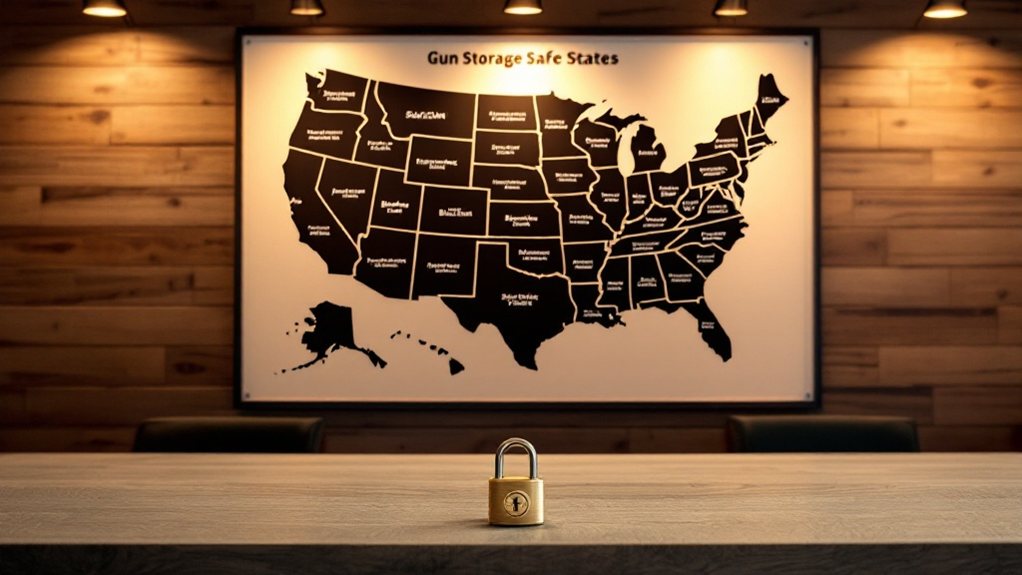
While a patchwork of gun storage laws exists nationwide, distinct regional patterns have emerged in how states regulate firearm storage. You’ll find the strictest requirements in the Northeast, where states like Maine has adopted comprehensive storage policies, following similar measures in Massachusetts and New York.
Michigan has adopted and Minnesota has adopted secure storage laws, though you’ll notice South Dakota and North Dakota have notably different approaches.
In the West, Nevada has adopted storage requirements, aligning with California’s regulations. The South shows greater variation – while Virginia has adopted storage measures, Arkansas hasn’t adopted any specific requirements. This regional disparity reflects broader differences in gun policy approaches, with some states prioritizing storage safety while others maintain minimal restrictions.
Recent Changes and Pending Legislation
Recent legislative activity has significantly reshaped firearm storage requirements across multiple states. While several states have strengthened their regulations, others like Montana, Missouri, Nebraska, Mississippi, Alabama, and Kentucky haven’t adopted comprehensive storage laws. You’ll find the most notable changes include:
- New York’s enhanced storage requirements for both residential and commercial settings
- Vermont’s mandatory locking device requirement when firearms aren’t under direct control
- Virginia’s criminal liability measures for unsecured firearms accessed by children under 14
- California’s expanded safe storage regulations
The trend toward stricter storage requirements continues to spread, particularly among young gun owners. States like West Virginia and South Carolina are currently considering similar legislation, while federal proposals aim to establish nationwide standards for secure firearm storage.
Frequently Asked Questions
Do All States Have Gun Storage Laws?
No, you’ll find that not all states have gun storage laws, with only 27 states enforcing statutory storage requirements as of 2022.
While responsible firearm ownership is widely encouraged, state-specific storage laws vary significantly, and there aren’t federally mandated storage rules.
Local firearm policies and gun ownership regulations differ across jurisdictions, with some states implementing strict secure firearm storage guidelines, while others lack formal gun storage compliance rules or firearm safety protocols.
What Are the Conditions for Gun Storage?
Like a fortress protecting its treasures, proper storage techniques are crucial for responsible gun ownership. You’ll need to focus on preventing unauthorized access through secure storage options for homes, including gun safes, trigger locks, or cable locks.
Your legal storage requirements may include securing ammunition separately and protecting children through safe handling procedures. When traveling, you must maintain secure storage to fulfill your responsibility as a gun owner and comply with applicable laws.
How and Where Should Firearms Be Stored?
You’ll need to store your firearms in a dedicated gun safe or secure storage cabinet that meets approved safety standards. Always use reliable locking devices and keep your ammunition stored separately in a locked container.
Place your storage unit in a dry, temperature-controlled location away from unauthorized access. You’re required to use tamper-resistant containers with proven security features. Don’t leave firearms unattended – they must be secured when not in use following strict protocols.
What Is the Rule of 3 for Guns?
Picture yourself reaching for your firearm – you’ll need to remember the Rule of 3: store guns, ammunition, and magazines in three separate, secure locations. This fundamental principle helps prevent unauthorized access and accidents.
While specific gun lock requirements and storage rules vary, you’ll want to ensure each component is secured independently. Whether you’re dealing with handguns or long guns, maintaining this separation enhances safety while still allowing quick access when needed.
Conclusion
Proper gun storage isn’t just a legal checkbox – it’s your first line of defense against unauthorized access and preventable tragedies. You’ll need to stay current with your state’s evolving requirements, as regulations vary significantly across jurisdictions. While federal standards remain limited, state-level storage laws continue to tighten like a vise, implementing stricter penalties and more precise technical specifications for securing firearms.


0 Comments