

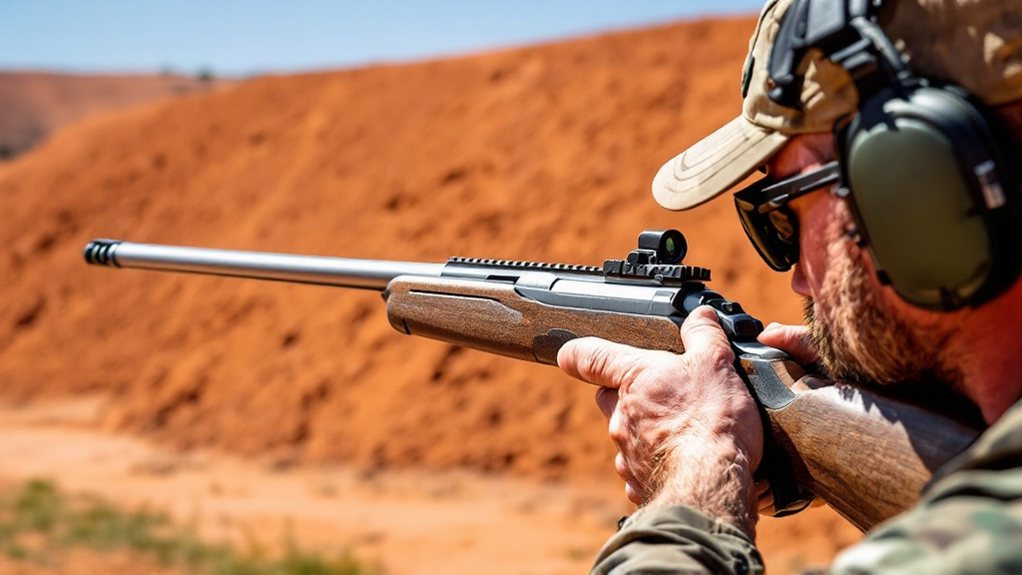
To master muzzle control, you’ll need to develop constant awareness of where your firearm is pointing. Always treat the weapon as if it’s loaded, keeping the muzzle pointed in a safe direction away from yourself and others. You must never allow the muzzle to “sweep” across people or objects, and your finger should stay outside the trigger guard until ready to fire. These fundamental principles form just the beginning of responsible firearm handling expertise.
Key Takeaways
- Always treat every firearm as if it’s loaded and keep the muzzle pointed in a safe direction away from people.
- Practice proper trigger discipline by keeping your finger outside the trigger guard until ready to fire.
- Maintain constant muzzle awareness during movement, position changes, and administrative handling of the firearm.
- Use two-handed carry positions for better control and quick accessibility while ensuring the muzzle remains safely directed.
- Train with dummy ammunition under qualified supervision to develop proper muzzle control habits and muscle memory.
Essential Rules of Muzzle Direction Safety
Proper muzzle control remains the cornerstone of firearm safety. You must always treat your firearm’s muzzle as if it’s loaded and keep it pointed in a safe direction, away from yourself and others. Never allow the muzzle to cross or “sweep” any person, even momentarily.
When handling firearms, maintain constant awareness of your muzzle direction, especially during movement or position changes. Keep the muzzle pointed downrange at shooting facilities, and toward the ground or skyward during field activities – but never at the horizon. If you’re storing or transporting your firearm, ensure the muzzle faces a safe direction where an accidental discharge couldn’t cause harm. Remember that proper muzzle control isn’t just about your safety; it’s about protecting everyone around you.
Proper Trigger Discipline Techniques
Your trigger finger serves as a critical safety mechanism when handling any firearm. To maintain proper trigger discipline, always keep your finger outside of the trigger guard until you’re ready to fire. Rest your finger firmly against the frame, making positive contact to ensure consistent positioning and maximum control.
When implementing firearm safety through trigger discipline, follow these essential steps:
- Keep your finger straight and outside the trigger guard during all handling, loading, and movement
- Make sure your finger only touches the trigger when you’ve identified a threat and made the decision to shoot
- Practice proper trigger control through dry-fire exercises to develop muscle memory
Safe Firearm Carrying Positions
Beyond trigger discipline, mastering safe firearm carrying positions forms the foundation of responsible gun handling. When carrying your firearm, you’ll need to maintain constant muzzle awareness, keeping it pointed in a safe direction – typically down and away from any person. The two-handed carry offers superior control and quick shooting accessibility, with one hand positioned on the forearm and the other gripping the pistol.
Always keep your safety engaged and your finger outside the trigger guard until you’re ready to shoot. While hunting, you must communicate clearly with others about your location and firearm handling. This awareness helps prevent accidents and ensures everyone maintains proper muzzle control. Remember, your muzzle’s direction is your responsibility, and maintaining control is non-negotiable for safe firearm operation.
Common Muzzle Control Mistakes to Avoid

While handling firearms, even seasoned shooters can fall prey to dangerous muzzle control mistakes that compromise safety. You’ll need to remain vigilant about your muzzle’s orientation at all times, as momentary lapses in attention can have devastating consequences.
Be sure to check yourself against these critical mistakes:
- Allowing your muzzle to sweep across people or objects, even briefly, during movement or position changes
- Failing to maintain consistent downrange orientation when transitioning between targets or adjusting your stance
- Becoming complacent about muzzle awareness during administrative handling, like cleaning or storage
Field Day Training and Supervision Guidelines
Field Day training provides three essential opportunities for developing proper muzzle control under expert supervision. You’ll practice loading and unloading techniques using dummy ammunition while receiving real-time feedback on your form and safety practices. Before you’re ready to shoot, ensure you’ve obtained permission from the firearm owner and thoroughly reviewed the owner’s manual.
| Training Element | Supervision Required | Safety Protocol |
|---|---|---|
| Loading Practice | Direct Instructor | Dummy Ammo Only |
| Unloading Skills | Direct Instructor | Muzzle Control Check |
| Handling Basics | Direct Instructor | Owner Permission |
| Safety Review | Direct Instructor | Manual Review |
Never substitute live ammunition for practice when dummy rounds aren’t available. Your instructor will guide you through proper muzzle control techniques, ensuring you maintain safe firearm handling habits throughout all Field Day activities.
Muzzle Awareness During Loading and Unloading
When you’re loading or unloading a firearm, you’ll need to maintain strict control by keeping the muzzle pointed in a designated safe direction, typically downrange or toward a safety berm.
During action cycling, it’s critical to keep your finger off the trigger while maintaining muzzle discipline, even if you believe the firearm is clear.
At rest positions between loading and unloading sequences, you should angle the muzzle downward at approximately 45 degrees while keeping the firearm close to your body’s centerline.
Safe Loading Direction Basics
The single most critical aspect of loading and unloading a firearm is maintaining strict muzzle control. You must always point the muzzle in a safe direction, typically downrange, while handling your firearm. Before beginning any loading or unloading procedure, verify your muzzle direction and identify a proper backstop.
To ensure consistent safe handling during loading and unloading:
- Visually confirm the muzzle direction before initiating each step
- Keep the safety engaged throughout the entire process
- Maintain constant awareness of where your muzzle is pointing
Your attention to muzzle control can’t waiver, even for a moment. Make it second nature to track your muzzle direction and maintain awareness of potential hazards downrange. This fundamental skill forms the foundation of responsible firearm handling and helps prevent accidents during loading and unloading procedures.
Control During Action Cycling
Maintaining proper muzzle control becomes even more critical during action cycling operations. When loading or unloading your firearm, you’ll need to deliberately focus on keeping the muzzle pointed in a safe direction while manipulating the action. Develop this into a reflex handling skill through consistent practice.
| Action Step | Safety Check | Key Focus |
|---|---|---|
| Pre-Cycling | Verify unloaded | Safe direction |
| During Cycle | Control muzzle | No sweeping |
| Post-Cycling | Chamber check | Visual confirm |
Before cycling the action, verify your firearm is unloaded through visual chamber inspection. As you operate the mechanism, maintain complete control to prevent the muzzle from sweeping across unintended targets. After cycling, perform another chamber check to confirm the firearm’s status. This systematic approach ensures you’re developing proper habits that will serve as the foundation for safe firearm handling.
Rest Position Fundamentals
Safe handling during loading and unloading requires establishing a consistent rest position that prioritizes muzzle awareness. When you’re working with your firearm, you’ll need a designated safe zone that maintains proper muzzle control at all times.
Follow these critical rest position protocols:
- Direct the muzzle toward a predetermined safe direction, typically a bullet-resistant backstop or designated safe zone
- Verify the chamber is clear through both visual and physical inspection before placing the firearm in its rest position
- Engage the safety mechanism and keep your finger off the trigger while moving the firearm to and from its rest position
Your rest position should incorporate proper storage solutions like a gun rack or case, ensuring the muzzle maintains a safe orientation even during extended periods of non-use. Remember to treat every firearm as if it’s loaded, regardless of its storage status.
Group Hunting Safety Protocols
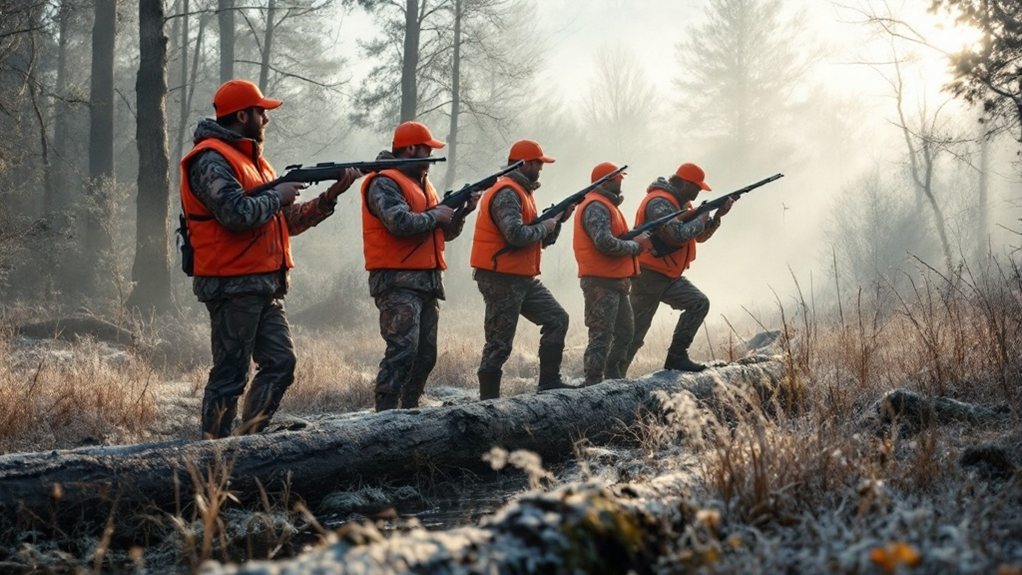
Group hunting requires heightened awareness and constant communication among participants to prevent accidents and ensure everyone’s safety. When you’re hunting with others, you must maintain strict muzzle control using proper two-handed carrying techniques. Keep track of your fellow hunters’ positions at all times and never point your firearm in their direction.
You’ll need to master different styles of safe firearm handling while coordinating with your group. Always keep your safety engaged and finger off the trigger until you’re ready to shoot. It’s your responsibility to follow these fundamental safety protocols – no exceptions.
Remember that proper muzzle control isn’t just about your personal safety; it’s about protecting everyone in your hunting party. Clear communication and constant situational awareness are essential for a safe group hunting experience.
Emergency Muzzle Control Scenarios
When you’re faced with an emergency situation while shooting, you’ll need to master quick-action safety drills that emphasize maintaining proper muzzle control while swiftly identifying safe directions. You must be prepared to handle sudden obstructions, such as tripping hazards or unexpected movements, by keeping your muzzle oriented away from unintended targets while regaining stability.
During group hunting scenarios, you’ll need to maintain heightened awareness of your fellow hunters’ positions and establish clear zones of fire while executing emergency muzzle control procedures.
Quick Action Safety Drills
Learning to control your firearm under stress requires dedicated practice through emergency muzzle control scenarios and quick-action drills. To develop accuracy and precision in high-pressure situations, you’ll need to master fundamental safety movements through consistent repetition.
Practice dry-fire drawing exercises while maintaining proper muzzle direction, focusing on smooth, controlled movements that reinforce safe handling habits
Execute rapid magazine changes with disciplined muzzle control and proper trigger finger placement outside the trigger guard
Perform malfunction clearance drills while keeping the muzzle pointed downrange, building muscle memory for emergency scenarios
These quick-action drills should become second nature through dedicated practice. Remember to maintain strict muzzle awareness during all manipulations, ensuring your firearm remains pointed in a safe direction regardless of the drill’s complexity or speed.
Managing Sudden Obstructions
Proper handling of sudden barrel obstructions requires immediate action and strict adherence to safety protocols. When you encounter a blocked muzzle, stop firing immediately and maintain safe muzzle direction. This quick response will work better to prevent potentially catastrophic outcomes.
Follow your firearm’s manual to safely unload the weapon and clear the obstruction using the specified tools and techniques. Never attempt to shoot through an obstruction, as this can cause a dangerous barrel explosion. After clearing the blockage, conduct a thorough barrel inspection to identify any damage before resuming use.
To enhance your emergency response capabilities, invest time in hands-on training and regularly review safety procedures. Understanding proper muzzle control techniques and obstruction management will help you handle these critical situations with confidence and precision.
Group Hunting Control Tips
Successful group hunting requires unwavering attention to muzzle control and coordination among all participants. Let’s talk about essential protocols that’ll keep your hunting party safe while maintaining operational effectiveness.
Always maintain two-handed control of your firearm, keeping the muzzle pointed in a safe direction while scanning for other hunters’ positions. Clear communication is your lifeline – establish these vital protocols before heading out:
- Call out position changes before moving
- Use designated hand signals for silent coordination
- Confirm visual contact with adjacent hunters every 15 minutes
You’re responsible for every aspect of your firearm’s control. When traversing terrain or encountering obstacles, prioritize muzzle awareness over speed. Never compromise on safety by pointing your weapon at another hunter, regardless of your firearm’s loaded status.
Building Consistent Safety Habits
To develop reliable firearm safety habits, you’ll need to commit to consistent muzzle control practices every time you handle a weapon. Your diligence in this area can make or break your hunting safety record, as proper muzzle awareness prevents accidents and builds confidence.
Start by mastering the fundamentals of trigger discipline, keeping your finger off the trigger until you’re ready to shoot. Incorporate the two-handed carry technique into your routine, as it provides superior control and allows for quick target acquisition. Always maintain awareness of your muzzle’s direction, regardless of whether you’re walking, climbing, or positioning yourself for a shot.
Frequently Asked Questions
How Do Weather Conditions Affect Proper Muzzle Control During Long Hunting Trips?
When hunting in varying weather, you’ll need to adapt your muzzle control techniques.
Rain and snow can make terrain variability more challenging, requiring extra attention to keep your muzzle pointed in a safe direction.
Wind can affect your stability, so you’ll want to maintain a firm grip and adjust your stance accordingly.
Cold temperatures might affect your dexterity, so wear appropriate gloves that allow proper trigger control while keeping your muzzle awareness sharp.
What Muzzle Control Adaptations Are Needed When Hunting With Different Caliber Firearms?
You’ll need to adjust your muzzle control based on your firearm’s caliber and recoil characteristics. For larger calibers, maintain a firmer grip and stance to manage increased recoil.
Ammunition consistency considerations are crucial – different loads within the same caliber can affect muzzle rise differently. Keep your support hand positioned appropriately for each weapon’s specific recoil pattern, and always maintain proper cheek weld regardless of caliber choice.
Should Muzzle Control Techniques Change When Hunting From Elevated Positions or Blinds?
Ever watched a tightrope walker? Like them, you’ll need extra attention to balance and control when hunting from heights. You must adjust your muzzle control for elevated terrain angles, always keeping your barrel pointed in a safe direction.
In blinds, you’ll want to establish clear zones of fire before settling in. Don’t rest your barrel on the blind’s edge – it can affect accuracy and create unsafe angles. Always maintain awareness of what’s below your position.
How Does Physical Fatigue Impact a Hunter’s Ability to Maintain Proper Control?
When you’re fatigued, your muscle control and coordination naturally decline, making proper muzzle control more challenging. That’s why building strong muscle memory through consistent practice is crucial – it helps you maintain safe handling even when you’re tired.
You’ll notice that physical exhaustion affects your ability to hold steady aim and make quick, controlled movements. Take regular breaks and acknowledge when fatigue is compromising your safety capabilities.
What Modifications to Muzzle Control Are Necessary When Hunting With Dogs?
You’ll need to adapt your correct muzzle discipline when hunting with dogs to ensure their safety. Keep your muzzle elevated above dog height at all times, especially when your canine companions are working close by.
As you track game, maintain constant awareness of your dog’s position and always angle your barrel upward when they’re ranging in front of you. Never let your muzzle sweep across areas where your dogs might suddenly appear.
Conclusion
You’ve taken crucial steps toward mastering firearm safety’s golden rule: muzzle control. Like a compass that unfailingly points north, your muzzle discipline must remain steadfast and unwavering. When you’re handling your firearm, whether at the range or in the field, let the deeply ingrained habits you’ve developed guide every movement. Remember, each time you shoulder your weapon, you’re not just handling a tool – you’re embracing a legacy of responsibility.


0 Comments