


Keep your muzzle pointed downrange at all times, treating every firearm as if it’s loaded. Never let your finger touch the trigger until you’re ready to shoot, and maintain strict muzzle discipline during loading, unloading, and position changes. Don’t sweep the muzzle across other shooters or yourself, especially when drawing or holstering. Always control muzzle direction during malfunctions, and raise your non-shooting hand for assistance if needed. These fundamental rules form just the beginning of comprehensive range safety protocols.
Key Takeaways
- Always keep the muzzle pointed downrange at the intended target area and backstop, regardless of whether the firearm is loaded.
- Never sweep the muzzle across any part of your body or others while drawing, holstering, or changing positions.
- Maintain trigger finger outside the trigger guard and muzzle control during loading, unloading, and malfunction clearance procedures.
- Keep the muzzle pointed in a safe direction while rotating your entire body as one unit when transitioning between shooting positions.
- Immediately correct any unintentional muzzle movement and maintain complete control of firearm orientation during all handling.
Maintaining a Downrange Muzzle Direction
When handling any firearm at the range, keeping your muzzle pointed downrange is your primary safety responsibility. Always keep the muzzle directed toward the intended target area and backstop, ensuring you maintain complete control of your firearm’s orientation during all handling activities.
Be aware of your muzzle orientation at all times and never allow it to sweep over anything you don’t intend to destroy. If you’re moving positions or transitioning your firearm, you must maintain strict muzzle discipline. Correct any unintentional muzzle movement immediately to prevent unsafe conditions.
To ensure safety, establish and adhere to a clearly defined safe firing zone downrange. This designated area serves as your bullet impact zone and helps you maintain proper muzzle control throughout your range session.
Safe Muzzle Control During Loading and Unloading
Loading and unloading your firearm represent critical moments that demand extra attention to muzzle control. During these operations, you must keep the muzzle pointed in a safe direction downrange at all times, even if you believe the firearm is completely unloaded. Never allow the muzzle to sweep across other shooters or Range Safety Officers while manipulating ammunition or magazines.
When loading, maintain your trigger finger outside the trigger guard and keep the Safety engaged until you’re ready to shoot. During unloading, continue treating the firearm as if it’s loaded, maintaining strict muzzle discipline throughout the process. If you need to verify your chamber is clear, keep the muzzle oriented downrange while conducting your safety check. Remember, proper muzzle control during loading and unloading is non-negotiable for Range safety.
Proper Muzzle Discipline While Moving Positions
Moving between firing positions requires heightened awareness of your muzzle’s orientation at all times. Keep your finger off the trigger and maintain control of your firearm while transitioning. A safe direction means downrange toward the target or backstop – never sweep your muzzle across other shooters or range personnel.
When changing positions, keep the gun pointed in a safe direction by rotating your body as a single unit. This fundamental safety principle is one of the most critical basic firearm safety rules you’ll practice. Don’t rush your movements; deliberate control prevents accidents.
Whether you’re moving from standing to prone or switching lanes, remember: you can’t shoot at anything you haven’t first pointed at. Maintain muzzle discipline even if you’re certain your gun is unloaded, as this reinforces proper habits.
Managing Muzzle Direction During Malfunctions
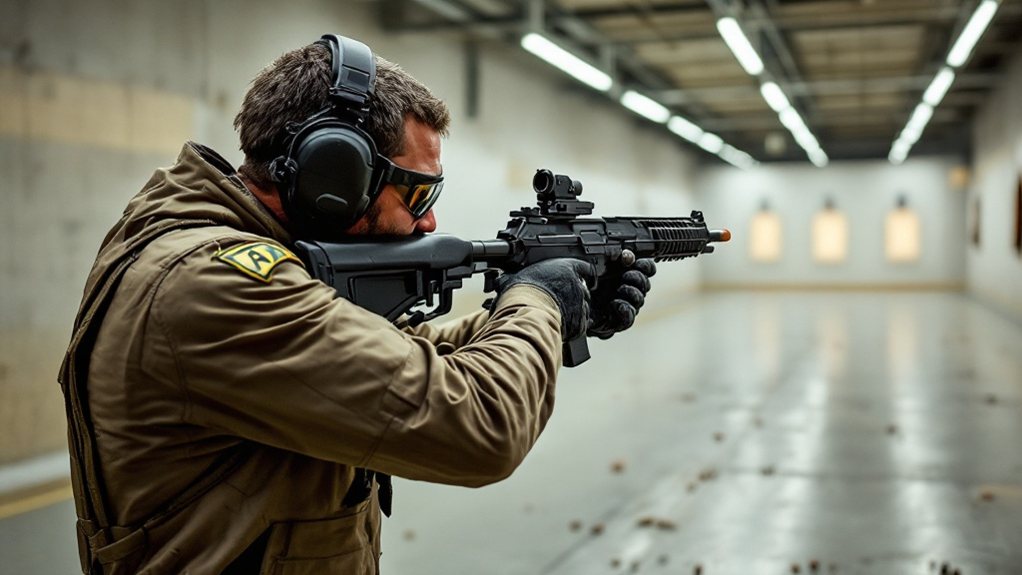
Safe muzzle control becomes even more important during firearm malfunctions at the range. When your gun malfunctions, keep your finger off the trigger and maintain the muzzle pointed downrange. Make absolutely sure you don’t turn around to ask for help, as this could sweep others with your muzzle.
If you need assistance, raise your non-shooting hand to alert Range Safety Officers while keeping the gun pointed safely downrange. When you open the action and remove any ammunition, pay close attention to proper safe gun handling throughout the process. You’ll need to safely open and close the gun’s action while maintaining strict muzzle discipline. Remember that basic firearms handling and storage rules become even more critical during malfunction scenarios, where stress might affect your judgment.
Holstering and Drawing With Controlled Muzzle Movement
The critical moments of drawing and holstering your firearm demand deliberate attention to muzzle control. ALWAYS keep your finger outside the trigger guard, indexed along the frame until your sights align with the target. Make sure you maintain complete control during these transitions while following fundamental firearm safety principles.
- When drawing, keep the muzzle pointed in a safe direction while smoothly establishing your grip
- During holstering, carefully guide your firearm home without looking at the holster – your eyes should stay on potential threats
- Never sweep any part of your body with the muzzle during the draw or reholster sequence
- Maintain your firearm unloaded until ready, but always handle it as if it’s loaded when practicing these movements
Cross-Range Safety Zones and Muzzle Boundaries
Every shooting range requires clearly defined cross-range safety zones to prevent accidental muzzle sweeps and maintain strict control over firearm direction. Beyond establishing visible barriers and markers, you’ll need to keep your gun’s muzzle within these designated zones at all times, even as you move between firing stations.
Rules for Firearms Safety dictate that you must never allow your muzzle to cross into adjacent lanes where other shooters are present. Every firearm must be pointed in a safe downrange direction that doesn’t intersect with other shooting activities.
Your range’s specific muzzle control policies require additional attention and strict adherence. Make sure you fully understand these protocols before beginning any shooting activities, as proper muzzle discipline is fundamental to maintaining a secure environment for everyone on the range.
Emergency Protocols for Muzzle Direction

Your ability to handle accidental discharge scenarios depends on swift, decisive action if your muzzle ever points in an unsafe direction – immediately call out “Cease fire” to alert others at the range.
You’ll need to keep your finger off the trigger and maintain safe muzzle control while the Range Safety Officer assesses the situation and provides further instructions.
If you drop your firearm, don’t attempt to catch it – instead, call “Gun down” and maintain muzzle awareness until proper retrieval can occur under the Range Safety Officer’s guidance.
Handling Accidental Discharge Scenarios
Maintaining absolute muzzle control becomes critical during accidental discharge scenarios at the range. The primary rule of gun safety dictates that no gun can be fired safely without proper muzzle discipline.
Even when a safety device is never guaranteed, following fundamental rules helps prevent tragedy.
- Keep your muzzle pointed downrange at all times, even if you’re responding to an unexpected discharge
- Rest your finger off the trigger until you’re actually ready to fire
- Keep the gun unloaded except when actively shooting, reducing accidental discharge risks
- If a discharge occurs, maintain control and fire in a direction that ensures rounds impact the backstop
Range Safety Officer Commands
Range safety officers serve as the first line of defense in preventing and managing firearm emergencies through clear, authoritative commands. Common sense dictates that you must always be ready to respond instantly when you hear “Cease Fire.” Keep your muzzle pointed downrange and wait for further instructions.
When the command “Make Safe” is given, you’ll need to unload your gun unless you know the range officer has other specific instructions. The rule of gun safety demands strict adherence to the “Unload and Show Clear” protocol, which requires visual confirmation that your firearm is empty. Never replace proper muzzle control with reliance on guns mechanical safety device alone.
Once the emergency is resolved and shooting glasses and hearing protection are confirmed, you’ll receive the “Range is Hot” command to resume firing.
Muzzle Awareness During Firearm Transitions

The critical process of transitioning a firearm between positions demands unwavering attention to muzzle direction at all times. When you use the gun in any action or inspect it, always follow proper muzzle control protocols. Take the time to ensure your handling and the observance of safety rules remain consistent throughout all movements.
Always keep your muzzle pointed in a safe direction while transitioning between firing and non-firing positions. Make sure to check your 360-degree surroundings before any firearm movement. Use slow, deliberate motions when holstering or changing positions. Maintain positive muzzle control during all transitions.
In order for your gun handling to remain safe at all times, develop a consistent habit of muzzle awareness. This fundamental practice applies to all guns and many shooting situations, ensuring everyone’s safety on the range.
Range-Specific Muzzle Control Requirements
Each shooting range enforces specific muzzle control rules that you must strictly follow while on their premises. Before firing a safe gun, you’ll need to verify the range’s designated firing directions and approved target areas. NRA rules for safe shooting require that you’ve identified your target beyond any doubt and carefully observed your prospective area of fire.
Always respect the mechanical safeties built into your firearm, but don’t rely on them exclusively. You’re responsible for taking proper care of your equipment, including proper storage and regular maintenance. If you notice any mechanical issues, a knowledgeable gunsmith should look at your firearm before you use it at the range.
Remember that different ranges may have varying protocols for firearm training, so always check their specific requirements before shooting.
Partner and Group Shooting Muzzle Coordination
When shooting with partners at the range, you’ll need to establish designated safety zones that clearly define where each person’s muzzle can safely point during the session. You must maintain constant verbal communication about muzzle positions and intended movements, especially during position changes or target transitions.
Your group should coordinate all movements in advance, ensuring everyone understands the timing and direction of position shifts to prevent any unsafe muzzle sweeping.
Establish Clear Safety Zones
During partner or group shooting activities, establishing clear safety zones becomes critically important for preventing muzzle sweeping and maintaining proper firearm control. To shoot the gun safely, you’ll need to designate and maintain specific zones where firearms can be handled, pointed, and stored between sessions.
Create distinct safety zones with clear boundaries for gun storage, cleaning and proper storage activities – keeping these separate from active shooting areas. Before you bring any gun to the range, means observing your prospective zones and ensuring they align with fundamental NRA rules.
Establish dedicated areas that won’t cause eye strain or safety concerns when multiple shooters are present. Mark clear zones with visible indicators and maintain strict enforcement of boundaries to ensure safe gun handling by all participants.
Group Communication Protocols
Clear communication between shooting partners serves as the foundation for maintaining safe muzzle control at the gun range. When shooting with others, you’ll need to coordinate muzzle direction and ensure that no ammunition is present in the cleaning area. Make sure you have identified who’s control of the firing line at any given time.
Regular cleaning and proper coordination require you to know how to open and close the action safely while maintaining awareness of your partner’s muzzle direction. The action should be open during the cleaning process, and you must stay alert to visual cues like trigger finger placement. Regular maintenance to remain safe includes following range officer commands promptly and establishing clear protocols for group communication. Keep lines of communication open with your shooting partners to prevent unintentional sweeping or crossfire situations.
Partner Movement Coordination
Safe muzzle coordination among shooting partners requires deliberate planning and constant situational awareness. When engaging targets as a group, you’ll need to establish clear protocols for muzzle control and maintain continuous communication about partner locations.
Establish a predetermined safe zone for muzzle direction and ensure all partners understand and commit to these boundaries. Communicate your intended muzzle movements before executing them, preventing unintentional crossfires between shooting lanes. Use physical barriers and designated shooting lanes to maintain proper muzzle positions during target engagement. Monitor your partners’ locations continuously and adjust your muzzle control accordingly, ensuring weapons never point at unintended targets.
These practices create a structured environment where multiple shooters can operate safely and effectively while maintaining proper muzzle discipline throughout their range session.
Frequently Asked Questions
What Are the Three Fundamental Rules for Safe Gun Handling?
You’ll need to follow three core rules for safe gun handling: Always treat every firearm as if it’s loaded, keep your finger off the trigger (proper trigger discipline) until you’re ready to shoot, and never point the muzzle at anything you don’t intend to destroy.
While skills like consistent sight alignment, controlled breathing, and effective target acquisition are important for shooting, these three fundamental safety rules are non-negotiable and must become second nature.
What Is the Rule of 3 for Guns?
Like a three-legged stool of safety, the Rule of 3 for guns will keep you standing strong and secure.
You’ll need to always keep your muzzle pointed in a safe direction, showing constant muzzle awareness. You must keep your finger off the trigger until you’re ready to shoot, demonstrating proper trigger discipline. Finally, you’ll need to keep the firearm unloaded until it’s time to use it, ensuring safe storage and handling.
What Are the 4 Cardinal Rules of Gun Safety?
1) Treat every firearm as if it’s loaded.
2) Keep your muzzle discipline strict – never point the gun at anything you’re not willing to destroy.
3) Maintain trigger discipline by keeping your finger off the trigger until you’re ready to shoot.
4) Always be certain of your target and what’s beyond it. These rules ensure responsible shooting posture and safe direction control.
What Are the Army’s Four Fundamentals of Weapon Safety?
You’ll save a million lives by following the Army’s four critical weapon safety fundamentals. First, always treat every weapon as if it’s loaded – that’s basic muzzle awareness.
Second, ensure proper target identification and maintain sight picture before firing.
Third, keep your finger off the trigger until ready to fire – trigger discipline is non-negotiable.
Fourth, be certain of your target and what’s beyond it, regardless of firing positions or range commands.
Conclusion
Your mastery of these ten fundamental muzzle control rules won’t just make you a safer shooter – it’ll transform you into a more confident and respected presence at the range. Remember, you’re not just protecting yourself, but everyone around you. Stay vigilant, maintain discipline, and never compromise on these safety protocols. One moment of carelessness can have irreversible consequences, so make proper muzzle control your unwavering priority.


0 Comments